Forgive them, Father, for they know not this is Schick Sunn Classic entertainment.
By Paul Mavis
Last week I had a nice response to the second volume review of Schick Sunn Classic’s and NBC’s Greatest Heroes of the Bible, the miniseries? series? special events? that aired sporadically during the 1978-1979 season ("nice response" equals a solitary email from an Episcopalian choir director in Omaha who said she’d pray for me, and then wished I’d rot in hell).
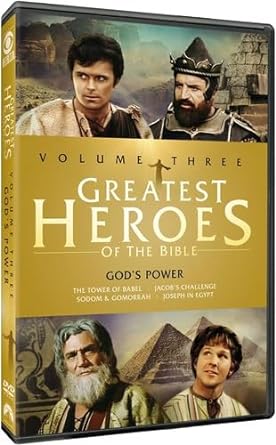
Lets look at the third and final volume of these specials released by CBS DVD and Paramount: Greatest Heroes of the Bible: Volume Three – God’s Power. Episodes included here are: The Tower of Babel, Sodom and Gomorrah, Jacob’s Challenge, and Joseph in Egypt. At this point in the review, if you’re not familiar with the legendary Schick Sunn Classic Pictures indie, I strongly urge you to increase my “unique readers” hits and go back and look at the first volume review. That will give me a chance to shower, shave and throw up, so we can get back to the review.
Good now? You’re versed in the power and the glory that is Schick Sunn Classics? I would hope so. A few years back, no less a prestigious DVD releasing company than Kino Lorber released a Blu-ray of SSC’s conspiracy crapfest, The Lincoln Conspiracy, a celestial event worthy of hosannas and palm fronds from SSC fans everywhere.
Perhaps―just perhaps―the tide is turning, and whatever legal blockades or marketing reluctance are lifting, and rabid consumers of all things Schick Sunn Classics will see a golden day when the entire canon is available on home video, and the sun will be darkened, and the moon will not give its light, the stars will fall from the sky, and the heavenly bodies will be shaken, and we shall all offer the strength, hope, and peace of Christ our Lord in this difficult yet sacred time of home video releasing.
So…how about the episodes of this volume of Greatest Heroes of the Bible? How are they? Well…with the exception of some, um…humorous casting decisions…these four mildly diverting episodes aren’t quite what I want from a true Schick Sunn Classic production. Yes, the dialogue is sometimes amusingly overripe and florid. Yes, the sets are still incredibly chintzy. And yes, a few of the performances lack any discernible talent. Fine. Good.
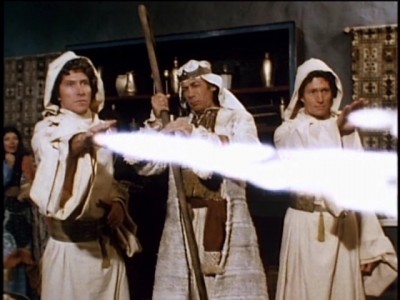
But you can get generalized incompetence anywhere in Hollywood. I want that magic Schick Sunn Classic ineptitude―which overwhelmed the first disc, Greatest Heroes of the Bible: Volume One – Bible’s Greatest Stories―the kind where all the elements of production come together to form a product that’s at once less than its parts…and then oh so much more, as it delights us with its cheap earnestness, wholesome, all-American huckstering, and almost complete incompetence. Have you seen In Search of Noah’s Ark? How about The Mysterious Monsters? In Search of Historic Jesus?
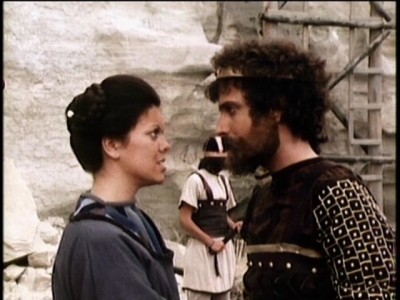
Well, if you haven’t, then you need to, because they feature the kind of indie moviemaking I treasure from my youth: cheap, coarse, calculated, ridiculously over-hyped, wildly maladroit…and marvelously entertaining. Unfortunately, the four episodes here in Greatest Heroes of the Bible: Volume Three – God’s Power have their Sunn Classic moments, but overall―they’re often just too average to pass the true Sunn Classic “P.U.” sniff test.
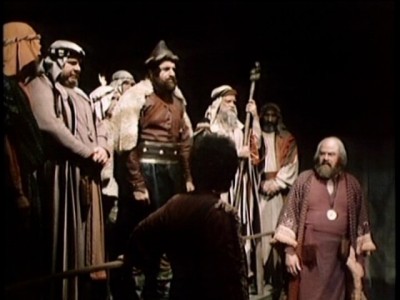
In the Beginning…there was The Tower of Babel. Arnold Horshack (Ron Palilo) and little Joannie “Shortcake” Cunningham (Erin Moran) are in love―a blessed event in TV pop culture that will eventually lead to the virgin birth of Punky Brewster (as prescribed by Scripture). But that’s later in the New Testament. Right now, the obstacle to their love comes in the form of the huge monstrosity that renowned hunter Amathar (Dr. Ben Casey) is building right next to the KMart.
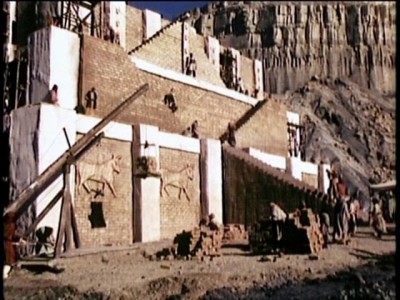
Believing that man literally needs to get closer to God, he wants a tower―a biiiiiiiiiiiiig tower―built. Horshack will design it, and Joannie’s dad, Ranol (Dana Elcar), will make the bricks…and make a handsome, tidy profit off them, too. Horshack’s traditionalist father, Admiral Nelson of the Seaview (Richard Basehart), the spiritual leader of the tribe, is naturally against this idolatry, but what’s he to do when everyone else backs this shovel-ready project?
Soon, the whole tribe is involved in the tower construction (the last time it took a village…), at first willingly, and then at the point of a sword when power inevitably goes to Amathar’s head, as the all-important, all-encompassing State―with a despot at its controls―now dictates life and death to the frightened, cowed people (wait…is this prophecy?).
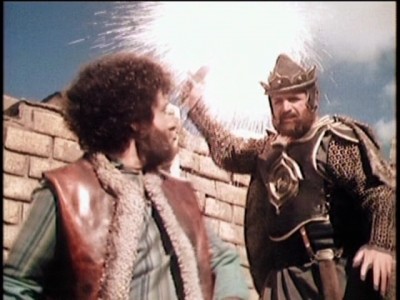
As delicious as are the possibilities inherent in that, um…eclectic cast drawing sparks, not much of interest happens in The Tower of Babel. No one is egregiously awful, nor particularly good, in their performances, with the halfway-decent tower set being the only element that stands out. It’s certainly not like the vertiginous one in Huston’s The Bible…in the Beginning, but it’s okay for the budget.
More careful scripting might have given us some insight into why Amathar “turned,” but alas, there’s no time for it amid the repeated scenes of various cast members whispering about the tower, and how to bring it down. Respectable but unimpressive, and worse for SSC, kinda dull.
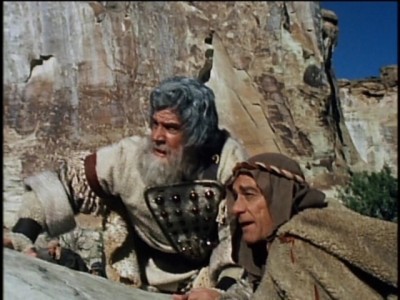
Okay, now we’re more on my territory: Sodom and Gomorrah. This should be good, right? Mingo/Lot (Ed Ames), recognizing that’s it’s time to split tribes with Amos Burke/Abraham (Gene Barry) because there’s not enough grass growing to go around. Leaving for Jordan, he’s welcomed by King Bera (Peter Mark Richman). Bera knows a sucker when he sees one: if Lot and the Hebrews flourish on his land, he’ll get their money in taxes, and if they fail…they’ll make good slaves.
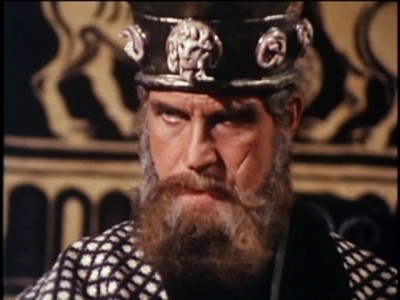
Lot seems fairly sanguine about being so close to the worst vice pits on earth, the cities of Sodom and Gomorrah, but his wife Constance MacKenzie/Nagar (Dorothy Malone) ain’t complaining. Eventually, all the Jews are corrupted by the naughty pleasures of S & G, even Lot, whose ego is seduced by Bera when the King makes Lot a stooge judge. God finally flips, and decides S & G have got to go.
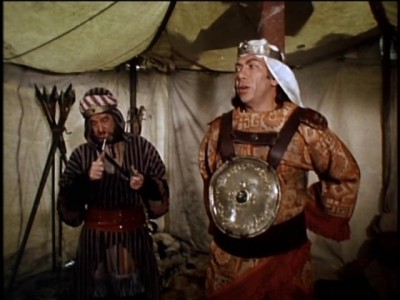
In the second volume of Greatest Heroes of the Bible, I wrote how much I enjoyed hearing the dialogue from resonant actors Ed Ames and Gene Barry, when they enacted Abraham’s Sacrifice. They still sound good here, but you’re going to search in vain to see any of the “good parts” of Sodom and Gomorrah, if you know what I mean.
In other words, this is all far, far too tame to adequately get across the evil degradation that is supposed to be embodied in the original “Fun City” I and II (when we’re admitted to the licentious lair of King Bera’s palace, his full-blown orgy consists of…two slightly swaying girls and a juggler. I had that at my seventh birthday party).
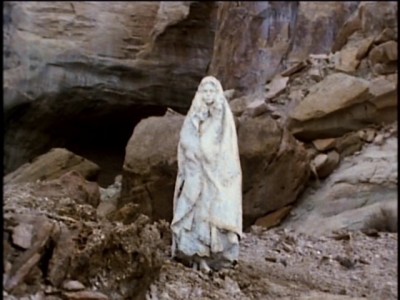
I know it’s TV, and TV from 1979, but still: you have to show us something to convey the absolute moral decay of S & G; otherwise, how can we see Lot overcome it? When we’re told the Jews have all finally succumbed to sin, as proof we’re given a shot of a guy strapped to a post, with two other guys jingling some jingle-jangles in his face. That’s “sin?” No, that’s a party game at the local Rotary.
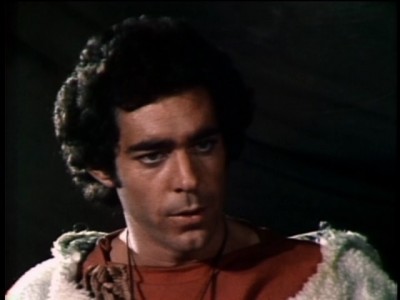
Scripter Brian Russell and director Jack Hively keep things straight for the most part, but it’s hard to credit them with the episode’s best bit of business―the destruction of S & G―when most of it obviously comes from stock footage from some other movie (I can’t tell if it’s from Aldrich’s big-screen version, or some other Italian peplum). Acting ranges from excellent (the always reliable Peter Mark Richman as silky, smooth Bera) to quite sad (a visibly reduced, at loose ends Dorothy Malone). A seeming sure-fire outing that’s too good to be enjoyably junky, and not nearly funky enough to be enjoyably bad.
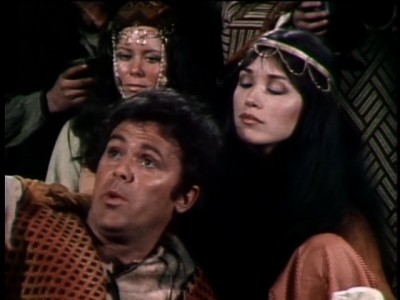
The land of Canaan, where the Hebrews and Hittites have formed an uneasy truce. In Jacob’s Challenge, Greg Brady (Barry Williams) is the twin brother of Eric “Otter” Stratton (Peter Fox), of Delta House. Greg’s the deep thinker, and Otter’s the big stinker, since he appeared first in this world, thereby gaining the birthright of his father, Douglas “Isaac” Channing (Stephen Elliott), of nearby Falcon Crest.
Prophecy has foretold, however, that one day the older Otter will worship the younger Greg, but Greg can’t see how that’s going to happen, even with the assurance of his mother, Ruth Martin (June Lockhart). Greg resorts to tricks to gain Otter’s birthright, and comes awful close to scoring with his fiance, Julie Rogers (Tanya Roberts), too. Will God finally warm to Greg, and rename him Johnny Bravo Israel?
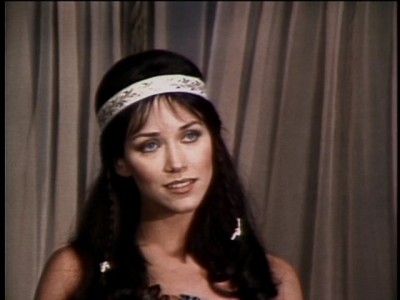
First off: finally some honest-to-God cleavage in the Greatest Heroes of the Bible, thanks in no small (ahem) part to sexy no-talent, Tanya Roberts. Written by the reliable TV scribe Norman Lessing, Jacob’s Challenge is straightforward enough in its storytelling, but direction by Jack Hively, unfortunately, misses the mark here, with a distinctly desultory tone dampening the proceedings (it really looks “TV,” with a constant, undistinguished procession of full and head shots). Certainly the most amusing aspect of Jacob’s Challenge is all those B and C-lister television stars, including “fake Tim Matheson” and a Farah Fawcett/Cheryl Ladd/Shelley Hack substitute (there’s even an appropriately second-string Officer Chris Owens from The Rookies).
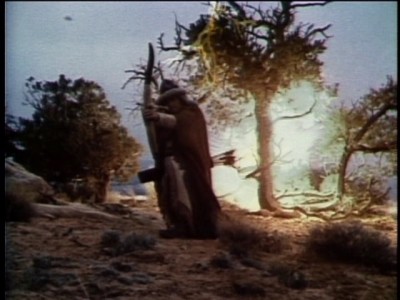
Unfortunately, aside from one hysterically funny encounter between Barry Williams and Tanya Roberts (Jacob speaks movingly of God’s covenant, when a grotesquely pouting Roberts, acting like some sex kitten from a Bob Hope movie, completely ignores him and jumps in without missing a beat, “It’s hot in here!” while unbuttoning her blouse―priceless), the episode is surprisingly flat, with Barry Williams’ somnambulant performance coming in for a hefty portion of the blame.
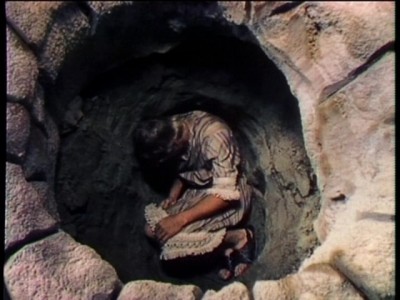
End times. In the disc’s final outing, Joseph in Egypt, Joseph (Sam Bottoms), beloved son of Jacob (Walter Brooke), is set upon by his jealous, traitorous brothers, who sell him into slavery. “Rescued” by horny rich lady Nairubi (Carol Rossen), Joseph works his way up to be a trusted servant to master Potiphar (Bernie Kopell), Nairubi’s henpecked husband.
When Joseph rejects her advances and then cries rape, Potiphar has him sent to prison, where he eventually befriends evil warden Har-Gatep (Albert Salmi). By blind luck becoming a trusted confidant of the Pharaoh (Barry Nelson), due to Joseph’s ability to read God’s will in anyone’s dreams, Joseph now has the power to avenge himself on his treacherous brothers.

The episode that comes the closest in a few scenes to the spirit of “bad=better” Sunn Classic outings, Joseph in Egypt is an otherwise pokey outing anchored by a…what’s the word…inexplicable performance by Sam Bottoms. When he makes that verkakte stupid grin, is he playing a character with a stupid grin…or is he really stupid? You can’t tell.
Bernie Kopell seems to be doing dinner theater comedy when first introduced, practically winking at the audience and mugging like his Doc character on The Love Boat (the laughs come later…when he plays everything straight).
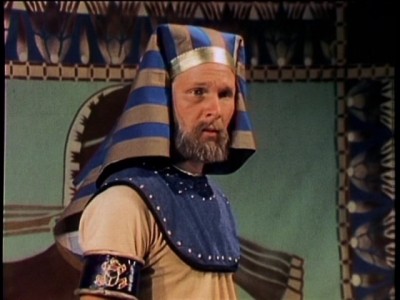
Barry Nelson as Pharaoh (yep, you just read that) plays his wise Egyptian dictator the way he played all his roles: like a slightly aggrieved accounts manager at a large Midwestern insurance company. Much, much better is the always funny Carol Rossen, who camps it up something awful as Nairubi, who, when she sees the slaves out in the desert for the first time, spits out, “Tell them to keep it down, I won’t have them shouting in my face with their bad breath!” I doubt “keep it down” was in the Egyptian vernacular then (or now), but she sells it.
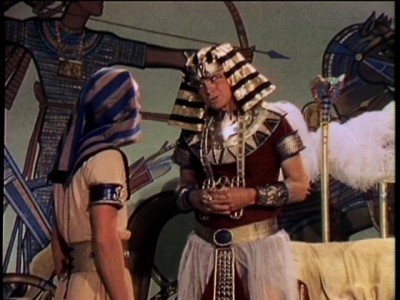
Even better, when she tries to seduce Bottoms (???), she comes out with a full-blown picked-out hairdo borrowed from Roseanne Roseannadanna, and purrs, “He [Kopell] is a goose, and you are…rare game,” a line truly worthy of DeMille (Bottoms has a great comeback―”You are not a woman, but a wild, ugly beast! You sicken me!”―but he blows it).
Unfortunately, the fun stops after this opening act when Bottoms goes to prison and meets Salmi (the original har-dee-har-har actor), before become an Egyptian big-shot, all of which unspools at an increasingly lugubrious pace. Pity; it seemed so close to stinking.
And Schick Sunn Classic Productions looked down upon what It had made, and saw that it was…good enough. Alas, not good enough, though, for a renewal order from NBC.
Read more of Paul’s TV reviews here. Read Paul’s film reviews at our sister website, Movies & Drinks.




%20%E2%80%94%20Scaled%20(90%25).png)

%20NBC%2060th%20Anniversary%20(May%2012%201986)%20-%20YouTube.png)